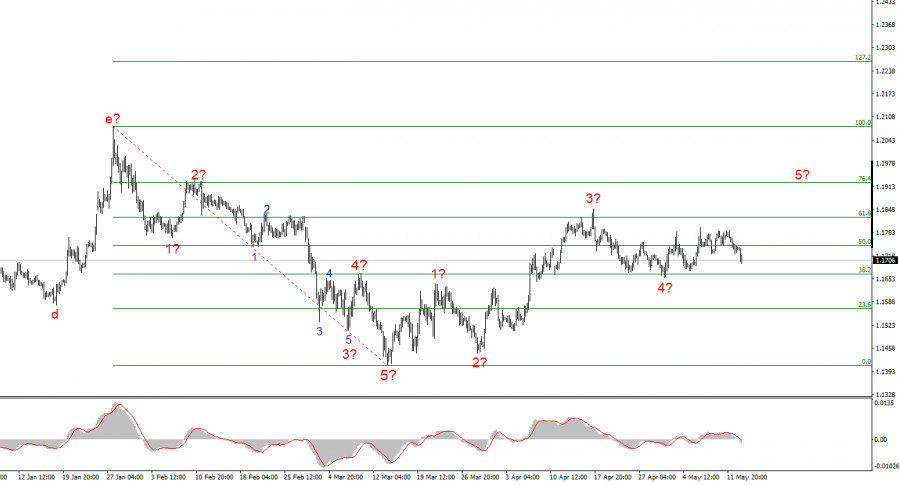
The wave pattern on the 4-hour chart for EUR/USD has changed somewhat. There is still no talk of canceling the upward trend segment (lower image), which began in January of last year, but the trend's wave structure now looks highly ambiguous. In situations like this, I always recommend switching to a lower timeframe (upper image) and analyzing the simplest and smallest wave structures in order to make a short-term forecast, which is usually sufficient for opening trades. Wave structures can become very complex and may imply multiple different scenarios. The easiest approach is to trade standard "five-three" patterns.
In the image above, I can identify a classic five-wave impulsive structure with an extension in the third wave. After this structure was completed, the market began forming a corrective pattern consisting of at least three waves. However, this structure could also develop into an impulsive five-wave pattern, which is entirely possible. Still, one cannot be confident that wave 5 is forming, since a corrective structure is currently expected. Traditionally, it should take the form of a three-wave pattern.
The EUR/USD pair fell by 30 basis points during Wednesday, and over the first two days of the week it lost around 50 points. The euro's total losses do not exceed 80 points, which is not particularly significant. However, in the current situation, the news background is what matters most. During the first three days of the week, it was clearly unfavorable for EUR/USD buyers. If this continues, the euro's decline is likely to persist.
Let me remind you that this week Donald Trump stated that the temporary truce between Iran and the United States is on the verge of collapse. The U.S. president did not specify what would happen if the truce ended, but some insiders report that Trump may order new missile strikes against Iran. Essentially, there are few alternatives left. Tehran is unwilling to make concessions, and Washington is equally unwilling. Since Trump's preferred method of achieving his goals is aggression, a renewal of the conflict should be expected.
Naturally, like many other market participants, I would prefer negotiations to continue. Officially, neither side has withdrawn from the talks yet. However, whether negotiations are still actively ongoing and whether any progress has been made remains unknown. The market is left with no choice but to speculate. And during the first half of the week, speculation worked against the euro.
In addition, rather mediocre reports on industrial production and first-quarter GDP were released today in the European Union. Compared to forecasts, neither report can be called disastrous, but once again the figures were weak. Industrial production increased by only 0.2%, while GDP grew by just 0.1% quarter-over-quarter. These numbers did not encourage the market to buy the euro.
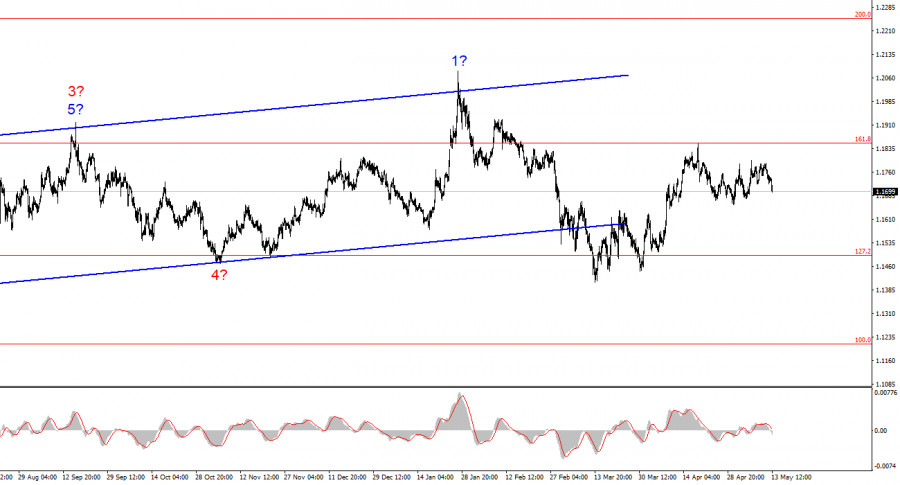
Based on the EUR/USD analysis conducted, I conclude that the instrument remains within an upward trend segment (lower image), while in the short term it is within a corrective structure. The corrective wave pattern appears largely complete, though it may still develop into a more complex and extended formation. The geopolitical situation in the Middle East could trigger a decline in the pair in the near future, so caution should be exercised with long positions. For now, I still expect the pair to continue rising toward the area around the 1.19 level, but the news background during the first three days of the week suggests otherwise.
On the lower timeframe, the entire upward trend segment is visible. The wave structure is not entirely standard, as the corrective waves differ in size. For example, the larger wave 2 is smaller than the internal wave 2 within wave 3. However, such situations do occur. I would remind you that it is best to focus on clear and understandable chart structures rather than trying to rigidly identify every wave. The latest waves are difficult to classify, so my analysis relies more heavily on the higher timeframe.

RÁPIDOS ENLACES
ForexMart is authorized and regulated in various jurisdictions.
(Reg No.23071, IBC 2015) with a registered office at First Floor, SVG Teachers Co-operative Credit Union Limited Uptown Building, Corner of James and Middle Street, Kingstown, Saint Vincent and the Grenadines
Restricted Regions: the United States of America, North Korea, Sudan, Syria and some other regions.
















 Contáctenos