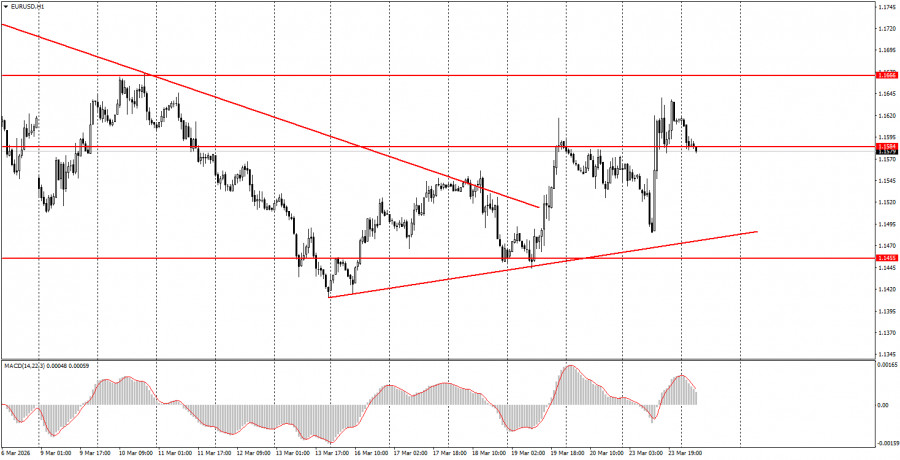
On Monday, the EUR/USD currency pair intended to resume its downward movement under the pressure of the geopolitical conflict in the Middle East, but then... Donald Trump announced that negotiations with Iran are yielding results and that the war may end soon. The dollar immediately came under pressure following the de-escalation of the military conflict, but just half an hour later, Iranian officials completely denied the existence of any negotiations. It's hard to say who to believe, but the market believed the US president. If not 100%, then at least 70-80%. Trump's message suggests that even if there are actually no negotiations, he is open to them. In other words, America wants to end the conflict, but will Iran comply? On the one hand, Tehran is unlikely to be interested in a prolonged military conflict. On the other hand, it is prepared for one. Thus, it must at least stop the bombings of Iran for combat operations to cease. After that, discussions could begin to unblock the Strait of Hormuz and restore the region's energy infrastructure.
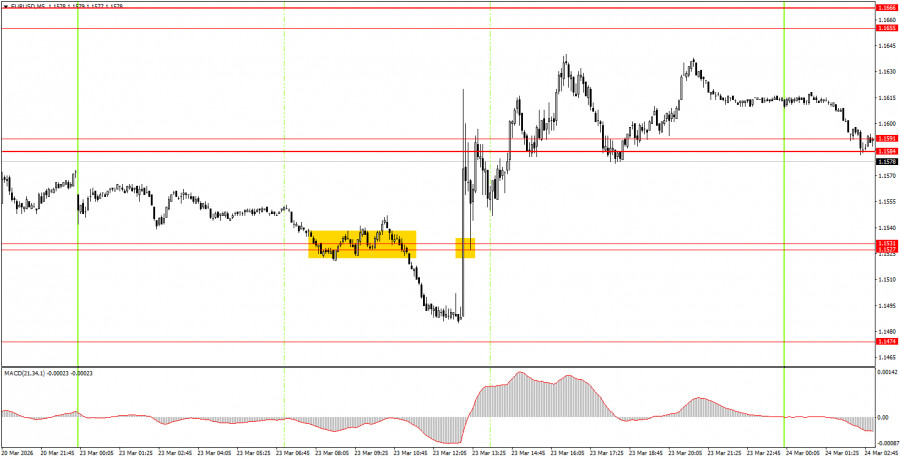
On the 5-minute timeframe on Monday, the pair formed a decent sell signal during the European trading session. The price broke through the 1.1527-1.1531 area and dropped by about 30 pips. Then came Trump's announcement, and the price traded with hyper-volatility for the rest of the day, constantly changing direction and ignoring technical levels. Thus, the remaining trading signals could have easily been overlooked by novice traders.
On the hourly timeframe, the downward trend is complete, but we may be dealing with yet another simple upward correction. At the beginning of 2026, a long-term upward trend resumed, so we still anticipate new medium-term growth for the euro currency. The overall fundamental background remains very challenging for the US dollar; however, geopolitical factors are currently of primary importance for the market. This is what prevents the dollar from falling.
On Tuesday, beginner traders may consider short positions if the price consolidates below the 1.1584-1.1591 range, targeting 1.1527-1.1531. A bounce from the area of 1.1584-1.1591 would allow for opening long positions with targets of 1.1655-1.1666.
On the 5-minute timeframe, the following levels should be monitored: 1.1267-1.1292, 1.1354-1.1363, 1.1413, 1.1455-1.1474, 1.1527-1.1531, 1.1584-1.1591, 1.1655-1.1666, 1.1745-1.1754, 1.1830-1.1837, 1.1899-1.1908. On Tuesday, business activity indices for March will be published in the Eurozone and the US, which may have a moderate impact on the movement of the currency pair. The market's focus will again be directed toward geopolitics and Trump's speeches.
Price levels of support and resistance are levels that serve as targets when opening buys or sells. Take Profit levels can be placed around them.
Red lines represent channels or trend lines that show the current trend and indicate the direction in which it is preferable to trade now.
The MACD indicator (14,22,3) – the histogram and the signal line – is a supporting indicator that can also be used as a source of signals.
Important speeches and reports (always included in the news calendar) can significantly affect the movement of the currency pair. Therefore, during their release, trading should be done with utmost caution, or traders should exit the market to avoid sharp price reversals against the previous movement.
Beginning traders in the forex market should remember that not every trade can be profitable. Developing a clear strategy and effective money management are the keys to long-term trading success.
ForexMart is authorized and regulated in various jurisdictions.
(Reg No.23071, IBC 2015) with a registered office at First Floor, SVG Teachers Co-operative Credit Union Limited Uptown Building, Corner of James and Middle Street, Kingstown, Saint Vincent and the Grenadines
Restricted Regions: the United States of America, North Korea, Sudan, Syria and some other regions.



















 コンタクトする