Over the weekend, Iran once again imposed a blockade on the Strait of Hormuz, but the situation in this beleaguered waterway is becoming increasingly convoluted by the day. Perhaps one day Hollywood will even make a movie about the blockade and all the twists and turns associated with it. For now, here's what we know: Tehran has decided to block the strait again, but it is now conditionally divided into two parts: the Iranian and the Omani. The first part is definitely under blockade, while the second is open, as Donald Trump stated. However, "open" does not mean "safe." Iranian missiles and drones can easily hit vessels passing near the shores of Oman. Although there is no enmity between Oman and Iran, Oman is also not an enemy of the U.S., nor does it have any claims regarding the Strait of Hormuz.
The situation seems absolutely paradoxical. The strait is open but also closed. Donald Trump claims the strait is open, while Iran claims it is closed. Some ships have begun turning off their transponders and crossing the strait in complete secrecy, and "public" movements have ceased entirely. Therefore, crossing the strait can now theoretically only be done in full secrecy, moving from one trench to another during dark, moonless nights, with lights and beacons turned off, risking, even in this case, a drone strike on the side of the vessel.
On Sunday, six tankers crossed the strait using this guerrilla-style approach. Iran has also reported that commercial vessels may cross the strait after receiving permission from Tehran. However, there are not many willing to do so at this time, as Iran has attacked at least four ships just last week. And "obtaining permission" probably comes at a very high cost. The situation remains tense and ambiguous, so movement through the Strait of Hormuz is now a rare occurrence "at one's own risk."
Amid the new effective blockade of the Strait of Hormuz, Brent crude oil prices have risen to $80, but this may only be the beginning. If the situation does not improve soon, oil may continue to rise. If Iran intends to impose a fee on all vessels passing through the strait, oil will naturally become more expensive. All of this threatens to keep global inflation high for the coming months, if not years. Well, all that's left is to say "thank you" to Donald Trump. He brilliantly executed a military operation in Iran, destroyed all nuclear weapons, defeated the arch-enemy about ten times, and "opened" the Strait of Hormuz to all who wish to pass.
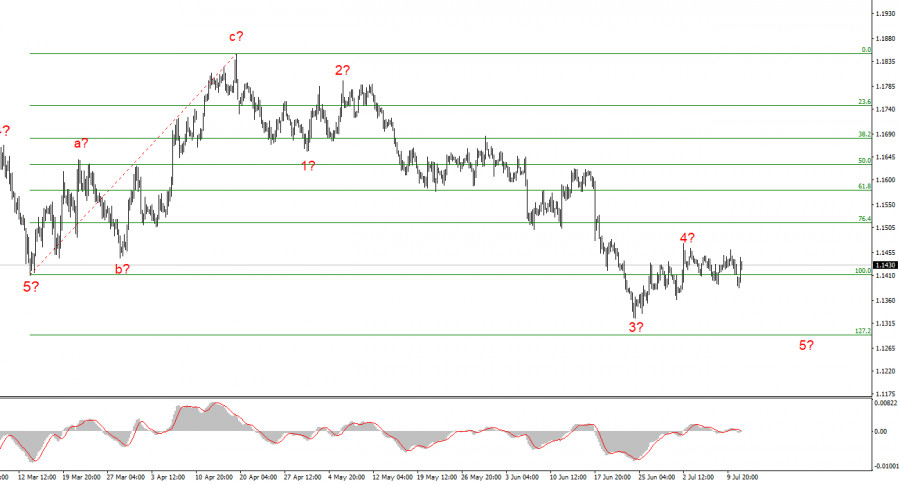
Based on the conducted analysis of EUR/USD, I conclude that the instrument remains within a bullish section of the trend (lower image), while in a more short-term view, it is within a bearish section of the trend. In my opinion, now is a good time to consider forming long positions, although the instrument may still drop to the 13-figure level within wave 5 in C. Wave analysis often brings surprises, so I would already adjust for buying.
The wave structure of the GBP/USD instrument has become quite complex. Currently, the instrument has formed three waves downward, and for EUR/USD, five waves may be constructed. Therefore, the British pound may form another wave down, similar to the euro, but this wave could be the second within a new bullish section of the trend. Thus, the divergence in the wave structures of the euro and the pound will occur, but it will be insignificant and minor. Based on this, I expect a pullback soon, followed by the formation of a new bullish trend section, with initial targets around the 37-38 level.
ລິ້ງດ່ວນ
ForexMart is authorized and regulated in various jurisdictions.
(Reg No.23071, IBC 2015) with a registered office at First Floor, SVG Teachers Co-operative Credit Union Limited Uptown Building, Corner of James and Middle Street, Kingstown, Saint Vincent and the Grenadines
Restricted Regions: the United States of America, North Korea, Sudan, Syria and some other regions.











 ຕິດຕໍ່ພວກເຮົາ